

Five Food Temperature Myths: Facts vs. Fiction
Written by Staff Writer

Food safety advice is often passed down through families and shared as common knowledge. You may have heard that you can thaw meat on the counter as long as you cook it well, that an acidic marinade protects food that’s been left out or that hot food should cool completely before it goes in the refrigerator. But while some of these concepts sound like reasonable best practices, many aren't.
Foodborne pathogens are hard to detect, and temperature plays a major role in their growth. Knowing which common food safety habits are reliable (or not) can help you reduce the risk of foodborne illness at home. Below, we break down five of the most common food safety myths about temperature and answer additional kitchen questions.
Myth 1: You Can Thaw Meat Any Way You Want as Long as You Cook It Thoroughly
Setting a package of chicken on the counter in the morning to defrost at room temperature may seem harmless. You're going to cook it later anyway, so any bacteria should be taken care of, right?
Not quite. Even when meat is frozen, the outside thaws faster than the inside. That means bacteria can start growing on the outer layer while the center is still solid. Some bacteria, such as Staphylococcus and Bacillus cereus, also produce toxins that cooking doesn't destroy. If those bacteria are allowed to grow, the food can make you sick even after you heat it to the correct cooking temperature.
Picture the night before Thanksgiving. The turkey is still frozen solid, so it goes on the counter overnight to speed things along. By morning, the outside feels cool and soft while the inside is still icy. That soft outer layer has been left at room temperature for hours, which is exactly where bacteria thrive. It's an easy mistake to make and a very common one.
Instead, plan ahead. Thaw food safely in the refrigerator, where it stays in a safe temperature range. Allow about one day of thawing for every five pounds of food. A 20-pound turkey, for example, needs about four days to defrost. As a bonus, food that’s thawed in the refrigerator defrosts evenly, which sets you up for even cooking. In a pinch, you can also thaw food in a leakproof bag submerged in cold water (change the water every 30 minutes) or in the microwave. Just remember, you still need to cook it to the proper internal temperature either way.
While we're on the subject, don't count on the freezer to do the safety work for you. Freezing is an excellent way to preserve food, but it isn't a reliable method for eliminating harmful bacteria. Low temperatures can stop or slow the growth of many microorganisms, but some pathogens can survive freezing and become active again when the item thaws. Think of freezing as a pause, not a reset. Handle and store food safely before freezing because the freezer won't make an item that's already mishandled safe to eat.
Myth 2: My Marinade Is Acidic, So It's Safe to Leave Out on the Counter
Vinegar, citrus juice and wine make a marinade acidic, so it's easy to assume bacteria won't grow in it. Unfortunately, they will.
Bacteria proliferate quickly at room temperature, even in acidic environments. Once marinated food has spent time in the temperature danger zone (41 to 135 degrees Fahrenheit), it can become unsafe.
Instead, marinate ingredients in the refrigerator. Marinades still work at cold temperatures, and the refrigerator keeps bacteria from making the ingredients unsafe. Use a covered container or a sealed bag so raw juices stay put. Also, throw out any leftover marinade that touched raw meat or bring it to a full boil before using it as a sauce.
Myth 3: Refrigerating Food Stops Bacteria from Growing
The refrigerator is one of your best tools, but it isn't a pause button. The FDA recommends keeping refrigerators at 40 degrees or slightly cooler. At that temperature, bacterial growth slows but doesn't stop. A few bacteria, like Listeria, can continue to grow even in the cold.
That's why the refrigerator extends the freshness of food but doesn't keep it safe indefinitely. At home, plan to eat cooked leftovers within three to four days. Commercial kitchens follow a seven-day limit for ready-to-eat food held at 40 degrees or colder. When you're not sure how long an ingredient has been in the fridge, it's time to throw it out.
Myth 4: Hot Food Should Cool Completely Before You Refrigerate It
Many people were taught to leave hot food on the counter until it reaches room temperature before refrigerating it. The concern behind that advice is understandable. A big pot of hot food can take a long time to cool, and it can raise the temperature of other items in the fridge.
But leaving perishable food out for an extended period isn't a safer alternative. As food cools, it passes through the danger zone, where bacteria grow rapidly. Perishable food shouldn't sit out for more than two hours, or one hour when the temperature is above 90 degrees. Improperly cooling food is a well-known contributor to foodborne illness, even when the ingredient was cooked to the right temperature.
The trick is to cool food quickly. Ingredients near the center of a deep pot hold onto heat much longer than those near the edges, and that's where bacteria can multiply to unsafe levels. Divide large batches into smaller, shallow containers before refrigerating them. Stirring the food or setting the container in an ice bath can speed things up too. Professional kitchens follow a two-stage cooling process: Cool food from 135 to 70 degrees within two hours, then down to 41 degrees or below within four more hours.
You don't need to wait until food reaches room temperature. The goal is to cool and refrigerate it safely and promptly.
Myth 5: If Meat Looks Cooked, It Must Be Safe to Eat
It’s tempting to judge doneness by color, but color alone can’t tell you whether meat has reached a safe internal temperature. A burger can brown on the outside before the center is fully cooked. Poultry can also remain slightly pink even after it has reached a safe internal temperature. Clear juices don't guarantee safety either.
When internal temperature matters, use a food thermometer to check the thickest part of the food rather than relying on color or appearance. Always cook whole cuts of beef and pork to at least 145 degrees, then let them rest for three minutes. Ground meats are generally safe at 160 degrees, and poultry should always reach 165 degrees.
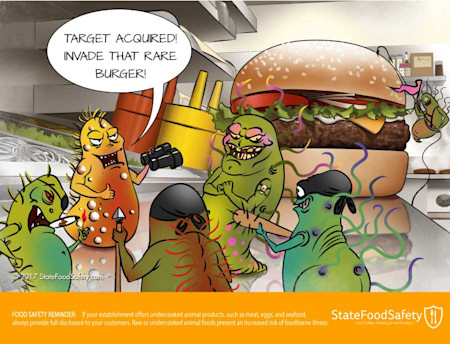
The same logic applies to rare meat. Just because a restaurant serves a rare steak doesn't mean it's risk-free. Rare steak and sushi carry a lower risk than other undercooked foods, but they still cause foodborne illness more often than fully cooked options. That's why many menus include an advisory. Undercooked pork, chicken, steak and ground beef are simply too risky, and older adults, pregnant women, young children and people with weakened immune systems should avoid undercooked or raw meat altogether.
Safe Cooking Temperatures at a Glance
Food | Target Temperature |
|---|---|
Whole cuts of beef, pork, lamb and veal | 145 degrees, then rest for three minutes |
Fish | 145 degrees |
Ground meats | 160 degrees |
Poultry (whole, parts and ground) | 165 degrees |
Leftovers and reheated food | 165 degrees |
Quick Answers to More Kitchen Questions
Does reheating food make it safe again?
Not always. Reheating can kill some microorganisms, but it can't fix food that was handled or stored improperly. If perishable food sits at unsafe temperatures for too long, microorganisms can multiply, and some produce substances that reheating doesn't necessarily eliminate. That's why food safety starts before leftovers ever reach the microwave or stove. Cool and refrigerate leftovers promptly, store them properly, use them within recommended timeframes and reheat them to 165 degrees before serving. Reheating is part of safe food handling. It isn't a way to undo unsafe storage.
Does an air fryer cook food safely?
Yes, but the air fryer's temperature setting doesn't indicate the temperature inside the food. Circulating hot air crisps the outside quickly, so the surface may look cooked before the center is done. Overcrowding the basket or cooking thick or frozen foods increases the risk of uneven cooking. Avoid piling food in the basket, shake or flip it partway through cooking and follow package instructions for frozen foods. Check the thickest part with a food thermometer: 165 degrees for poultry, 160 degrees for ground meats and 145 degrees for whole cuts of beef and pork. These temperature guidelines apply regardless of the appliance.
Can I tell if food is safe by looking at it or smelling it?
No. It's natural to check food for an unusual smell, color or texture, and those signs can point to spoilage. But they can't tell you whether food contains harmful pathogens. Microorganisms that cause disease don't necessarily change how food looks or smells, and a taste test won't tell you either. Instead, pay attention to how food has been handled and stored, and follow recommended storage times and temperatures. If food has been stored improperly or you don't know how long it has been in the refrigerator, don't rely on your senses.
Should I wash raw chicken before cooking it?
No. Rinsing raw chicken seems logical, but running water can splash contaminated droplets onto your sink, countertops, utensils and nearby food. Washing chicken doesn't reliably make it safer and can spread contamination around the kitchen. The safer approach is simple: Don't rinse raw poultry. Keep it contained during preparation and cook it thoroughly. A food thermometer is a much better safety check than trying to make raw chicken "clean" before it reaches the pan.
Does the five-second rule actually work?
No. The five-second rule is one of the most common food safety myths, but a myth nonetheless. Bacteria can transfer to food almost instantly, so there’s no safe window for eating something that has fallen on the floor. However, the risk level depends on the surface and the type of food. Moist foods like watermelon tend to pick up more microorganisms than dry ones. It’s best to err on the side of caution. If the item lands on the floor, throw it away.
Do I need to wash produce if I'm going to peel it?
Yes. It may seem unnecessary to wash a melon, avocado or other food when you plan to remove the skin, but cutting or peeling can transfer microorganisms from the fruit or vegetable’s exterior to the part you eat. Produce can also become contaminated during growing, harvesting, transportation, storage or handling before it reaches your kitchen. Wash fresh produce under running water before cutting or peeling it. Skip the soap, dish detergent and household cleaning products, since they aren't intended for washing edible goods.
Is organic food automatically safer?
No. Labels like "organic," "natural," and "local" can often shape how people feel about the quality of the ingredients, but they don't guarantee that the product is free from harmful microorganisms. Contamination can occur during production, harvesting, transportation, processing, storage or preparation, no matter how the ingredients are grown. Organic foods need the same level of careful handling as everything else. Wash produce appropriately, keep raw goods separate from ready-to-eat ones, clean food-contact surfaces and follow safe storage and cooking practices regardless of where the product came from.
Is the last thing I ate always the cause of my food poisoning?
Not necessarily. If you get sick shortly after eating, it's tempting to blame your last meal. But foodborne illnesses don't all follow the same timeline. Depending on the pathogen, symptoms can begin hours, days or sometimes weeks after exposure, so the ingredient that made you sick may not be the most recent thing you ate. That's one reason foodborne illness can be so hard to trace. If you develop symptoms, pay attention to them and consult a healthcare professional when appropriate.
Build Safer Food Handling Habits
Knowing how to separate truth from folklore is the first step toward practicing safe handling habits. Now that you can spot common food safety myths, you can put these practices to work and reduce the risk of foodborne illness at home and at work. Explore StateFoodSafety's training courses and free resources to build practical skills and keep ingredients safer from preparation to serving.