
Building Safe and Trustworthy Food Systems Through Quality Control
Written by Staff Writer

Quality control (QC) plays a critical role in the modern food industry. From small restaurants to large-scale food manufacturing operations, maintaining consistent quality and safety is crucial for protecting consumers, meeting regulatory requirements and preserving brand reputation.
For food handlers, managers and establishment owners, understanding how QC systems work and how to implement them effectively can mean the difference between a compliant, trusted operation and one vulnerable to safety failures, recalls or regulatory action.
Learn what quality control in the food industry really means and how you can apply these systems to ensure safety, consistency and compliance.
Understanding Food Quality and Why It Matters
Food quality goes beyond taste alone. While flavor, texture, aroma and appearance are all important, quality also includes safety, nutritional value, consistency and compliance with food safety laws. A high-quality food product meets established standards every time it is produced and served.
For consumers, product integrity directly impacts trust. Customers expect the items they eat to be safe, accurately labeled and consistent with prior experience. For businesses, delivering top-notch food products helps build customer loyalty, reduce waste and minimize costly errors.
In today’s food industry, consumer expectations are higher than ever. People are more aware of allergens, ingredients, sourcing practices and nutrition. As a result, QC has become a foundational requirement rather than an optional best practice.
Quality Assurance vs. Quality Control: How They Work Together
One of the most common points of confusion in food operations is the difference between quality assurance (QA) and quality control. Although the terms are closely related, they serve distinct roles.
Quality Assurance
Quality assurance is proactive. It focuses on building systems, procedures and standards that prevent problems before they occur. QA involves planning, documentation, training and auditing designed to ensure that processes are followed correctly.
Examples of QA activities include:
- Developing standard operating procedures (SOPs)
- Designing sanitation programs
- Training employees in food hygiene
- Conducting internal audits
- Establishing quality metrics
QA focuses on prevention and continuous improvement. It creates the framework that supports safe and consistent food production.
Quality Control
Quality control is reactive and focused on verification. It involves inspections, testing and monitoring to confirm that food products meet established quality requirements. QC validates that systems created by QA are working as intended.
Examples of QC activities include:
- Inspecting raw materials
- Testing finished products
- Monitoring cooking temperatures
- Verifying packaging and labeling accuracy
- Conducting microbiological testing
Together, QA and QC form a complete food safety management system. QA builds the system; QC checks the results.
QC in Food Manufacturing vs. Food Service: What’s the Difference?
Maintaining QC and QA systems is no small feat. Each type of establishment must meet unique goals, and the steps involved can vary depending on whether the business focuses on food production or service.
Below are some examples.
Manufacturing Environments
In food manufacturing, quality control often involves:
- In-line inspections
- Laboratory testing
- Statistical process control
- Batch documentation
For example, a sauce manufacturer may test pH levels for every production batch. If pH falls outside the acceptable range, the batch is held, investigated and either corrected or discarded. This level of control ensures shelf stability and safety.
Food Service Environments
In food service, quality control is more immediate and hands-on. Restaurants focus on:
- Time and temperature control
- Visual inspections
- Employee hygiene monitoring
- Daily logs and checklists
Both environments require vigilance, but food service operations rely heavily on employee behavior and training, making culture and accountability especially important.
The process typically includes:
- Creating and implementing food safety plans
- Standardized recipes and preparation methods
- Cleaning and sanitizing procedures
- Staff training programs
- Internal audits and inspections
- Supplier approval and verification
By implementing these systems, operators reduce variability, control food safety hazards and create repeatable processes that support both safety and quality.
Raw Materials: The Foundation of Food Quality
Quality control begins long before food reaches the kitchen or production line. Raw material inspection is one of the most critical steps in ensuring food safety and quality.
Incoming ingredients should be evaluated for:
- Temperature upon receipt
- Signs of contamination or spoilage
- Proper labeling and documentation
- Supplier compliance with specifications
Supplier audits help verify that vendors meet safety and quality expectations. A failure at the raw materials stage can compromise the entire food production process.
Supplier Relationships and Quality Partnerships
Suppliers play a critical role in food quality. Quality control extends beyond the walls of a single establishment and into the supply chain.
Strong supplier quality control programs include:
- Approved supplier lists
- Written specifications
- Periodic audits or certifications
- Performance reviews
When suppliers consistently meet quality expectations, food businesses experience fewer disruptions and safety concerns. When issues arise, documented quality standards support accountability and resolution.
Storage and Inventory Management
Improper storage can undo even the best preparation practices. QC during storage focuses on preventing contamination, spoilage and cross-contact.
Key controls include:
- First-in, first-out (FIFO) rotation
- Clear labeling and dating
- Separation of raw and ready-to-eat foods
- Proper shelving and containment
Regular inventory checks ensure products are used within safe timeframes and stored under appropriate conditions.
Defining Food Quality Standards
Clear standards are essential for any effective QC program. They define what is acceptable and what is not.
Quality standards may address:
- Taste and flavor profiles
- Texture and appearance
- Portion size and presentation
- Nutritional value
- Shelf life
- Packaging integrity
- Label accuracy
Sensory evaluation criteria are commonly used in food-tasting quality standards. They assess food based on taste, smell, texture and appearance using standardized scoring systems. These criteria help ensure products remain consistent across batches.
Tools used in sensory evaluation include:
- Sensory scorecards
- Descriptive analysis forms
- Acceptance testing scales
- Trained tasting panels
These tools allow businesses to define quality in measurable terms rather than subjective opinions. For example, instead of saying a soup should “taste good,” a quality standard might specify acceptable values of saltiness, texture, color and aroma.
Sensory evaluation is often combined with chemical, microbiological and physical testing to provide a complete picture of product quality.
Regulatory Compliance and Food Safety Laws
Food QC and regulatory compliance go hand in hand. Sellers and manufacturers must comply with local, national and international safety regulations designed to protect public health.
In the United States, regulatory oversight primarily comes from:
- The Food and Drug Administration (FDA)
- State and local health departments
- The U.S. Department of Agriculture (USDA) for certain products
Regulatory agencies enforce food safety laws that govern sanitation, labeling, allergen disclosure, temperature control and hazard prevention. Failure to comply can result in fines, closures or recalls.
The Role of HACCP and Critical Control Points
Hazard Analysis and Critical Control Points (HACCP) is a cornerstone of modern food safety management. HACCP is a systematic approach that identifies potential food safety violations and establishes controls to prevent, eliminate or reduce them.
Key HACCP principles include:
- Conducting hazard analysis
- Identifying critical control points
- Establishing critical limits
- Monitoring procedures
- Taking corrective actions
- Verifying compliance
- Keeping records
By integrating HACCP into quality control procedures, businesses gain a proactive method for controlling food safety hazards before they cause harm.
Technology and Data in Modern Food Quality Control
Advances in technology have significantly transformed how food QC is executed. Digital tools now allow food establishments to monitor processes in real time, detect trends and respond to issues faster than ever before.
Modern quality systems may include:
- Digital temperature monitoring with automated alerts
- Cloud-based documentation and audit platforms
- Barcode and RFID traceability systems
- Predictive analytics for identifying risk patterns
- Integrated supplier verification databases
These tools reduce reliance on manual logs, minimize human error and provide clearer visibility into operations. For example, automated temperature systems can alert managers immediately if refrigeration units fail, allowing corrective action before products become unsafe.
However, technology is only effective when employees are trained to use it correctly and when data is actively reviewed. Systems that collect information without follow-up are no more effective than paper logs left unchecked.
Standard Operating Procedures and Consistency
Standard operating procedures provide documented instructions for every key task in food production and handling. SOPs ensure consistency, reduce errors and support training by creating a shared set of expectations across the organization.
Effective SOPs cover:
- Food preparation steps
- Cooking times and temperatures
- Cleaning and sanitizing procedures
- Equipment use and maintenance
- Storage and labeling practices
When SOPs are followed consistently, control efforts become more effective and measurable.
Food Safety Management Systems and Documentation
A food safety management system integrates policies, procedures and records into a unified structure. Documentation is a critical component of this system, allowing meaningful comparisons to gathered data.
Accurate records support:
- Traceability
- Regulatory inspections
- Internal audits
- Corrective actions
- Continuous improvement
Records may include temperature logs, training records, sanitation schedules, supplier documentation and testing results.
Testing and Inspection
Testing is one of the most visible components of food quality control. Depending on the operation, testing may include:
- Microbiological Testing: Tests for pathogens such as salmonella, listeria and E. coli to ensure food safety.
- Chemical Testing: Verifies compliance with nutritional labeling, allergen declarations and pesticide residue limits.
- Physical Testing: Checks for foreign objects, packaging integrity and physical defects.
Regular testing helps identify issues early and prevents unsafe products and contaminants from reaching consumers.
Packaging and Labeling Verification
Packaging plays a critical role in protecting food products and communicating essential information to consumers. QC verifies that packages are secure. This includes checking for any tears in the wrapping and ensuring seals are intact.
Labels must also be reviewed for accuracy. Label checks ensure:
- Correct ingredient lists
- Accurate allergen declarations
- Proper use-by dates
- Factual country-of-origin statements
Errors in labeling can pose serious consumer health risks and lead to costly recalls. Personnel must be vigilant when examining labels, particularly for products imported from abroad, where disclosure requirements may vary from those in the United States.
Food fraud, the intentional misrepresentation or tampering of consumable goods, and adulteration, the deliberate alteration of ingredients to compromise their quality, are prevalent worldwide. These incidents affect roughly 1% of the food and beverage industry and often involve deception with milk products, oils, proteins, juices and other commonly used or purchased items.
Traceability and Recall Readiness
Traceability systems allow food businesses to track products as they move throughout the food supply chain. Effective traceability enables rapid response during recalls or safety incidents by detailing the locations of all ingredients, processing steps and shipments.
Maintaining traceability protects consumers and reduces financial and reputational damage.
The Role of Internal Audits
Internal audits enable food businesses to assess their own compliance before inspectors or customers identify potential issues.
An audit may review:
- Temperature logs
- Sanitation records
- Equipment maintenance
- Employee practices
- Storage and labeling
Audits are not meant to punish employees. Instead, they identify gaps and provide opportunities for improvement. For example, an audit may reveal that temperature logs are being completed but not reviewed. Quality control procedures can then be adjusted, requiring supervisors to verify logs daily.
Regular internal audits strengthen systems, reinforce expectations and reduce surprises during regulatory inspections.
Incorporating Customer Feedback
Customer feedback is a valuable resource when creating and implementing QC. Complaints, reviews and comments can reveal trends that internal monitoring may miss.
For example:
- Repeated complaints about undercooked food may indicate inadequate temperature checks.
- Reports of inconsistent portion sizes may suggest recipe or training gaps.
- Allergy-related concerns may highlight labeling or communication issues.
Quality-focused organizations track customer input and use it to guide corrective actions and process improvements.
Training and Human Factors
Even the best systems fail without proper training. Food handlers must understand why quality control matters and how their actions affect safety.
Training should cover:
- Food hygiene
- Cross-contamination prevention
- Temperature control
- Cleaning and sanitizing
- Documentation practices
Resistance to change and lack of training are common challenges that increase food safety risks.
Employee Accountability
Systems succeed when worker responsibilities are clearly defined. Employees should know:
- What standards apply to their role
- How to monitor compliance
- When and how to report issues
Accountability does not mean assigning blame. Instead, it fosters ownership. When employees understand how their actions impact food safety, they become active participants in quality control rather than passive rule followers.
Clear, job-specific expectations help reinforce accountability at every level of the operation.
Managing Corrective Actions Effectively
Any system is incomplete without corrective actions. When a deviation occurs, the response must be documented, effective and timely.
A proper corrective action:
- Identifies the problem
- Corrects the immediate issue
- Determines the root cause
- Prevents recurrence
For example, if a cooler repeatedly exceeds safe temperature limits, records may show frequent corrective actions without long-term resolution. Root cause analysis might reveal faulty equipment or improper stocking practices.
Addressing the root cause — repairing the cooler or retraining staff — improves long-term quality outcomes.
Crisis Management and Preparedness
Even with strong systems, unexpected events can occur. Crisis management enables business owners to have a solid plan in place for addressing potential breaches in food quality.
Plans may involve:
- Recall procedures
- Communication protocols
- Emergency contacts
- Mock recall exercises
Being prepared reduces response time and limits damage during real incidents.
Continuous Improvement and Data-Driven Decisions
Quality control is not a one-time effort. It requires continuous improvement, relying on analyzing data gathered from audits, testing and customer feedback.
Using real-time data helps food businesses:
- Identify trends
- Reduce variability
- Improve efficiency
- Enhance food safety outcomes
Continuous improvement supports long-term success and customer satisfaction. Failing to implement effective and ongoing QC protocols can result in:
- Foodborne illness outbreaks
- Regulatory penalties
- Product waste
- Brand damage
- Lost customer trust
In contrast, strong quality control efforts lead to cost savings, improved compliance and safer food.
Measuring Success
Quality control efforts should be based on measurable criteria. Metrics help evaluate effectiveness and guide improvement.
Common quality control indicators include:
- Audit scores
- Number of corrective actions
- Quantity of customer complaints
- Inspection results
- Waste levels
Tracking these metrics over time reveals trends and supports informed decision making.
Practical Examples
Understanding QC concepts is essential. But applying them in real-world environments is where safety and consistency truly come to life. Practical examples help translate policies and procedures into daily habits that protect both consumers and businesses.
Example 1: Temperature Control in a Busy Restaurant Kitchen
In a fast-paced restaurant kitchen, temperature control is one of the most critical quality control activities. Imagine a line cook preparing grilled chicken during a dinner rush. Without a defined quality control process, the cook may rely on visual cues alone, assuming the chicken is fully cooked based on appearance.
A quality control system changes this behavior. The restaurant establishes a clear standard: all poultry must reach an internal temperature of 165°F. Thermometers are calibrated weekly, temperature logs are required for every batch and supervisors verify entries during each shift.
If a temperature reading falls below the standard, corrective action is immediate — continue cooking and rechecking until the critical limit is met. This simple quality control step prevents undercooked food, reduces the risk of illness and creates consistent results regardless of who is working the line.
Example 2: Delivery and Receiving Controls
Quality control does not begin in the kitchen. Consider a food establishment receiving a delivery of fresh produce, dairy and raw meat.
A strong quality control process requires the receiving employee to:
- Verify delivery temperatures
- Inspect packaging for damage
- Check expiration or use-by dates
- Confirm products match the order specifications
If a delivery truck arrives with refrigerated items above safe temperature ranges, QC procedures empower employees to reject the shipment. Accepting compromised ingredients may save time in the moment, but it introduces serious safety risks later.
This example highlights how following proper protocols, even when inconvenient, stops potential issues with supplies before they enter the food flow.
Example 3: Allergen Control and Label Verification
An allergen management failure can have severe consequences. Imagine a bakery that produces items that contain nuts alongside nut-free products.
Quality control measures might include:
- Separate storage areas for allergenic ingredients
- Dedicated utensils and equipment
- Verified cleaning procedures between production runs
- Label checks before packaging
A QC checklist requires staff to confirm that allergen labels match the actual ingredients used. If a label is missing or incorrect, production stops until the issue is corrected. This prevents accidental exposure and protects vulnerable consumers.
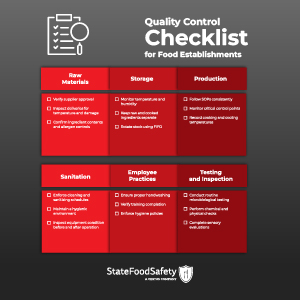
Click here to view our printable quality control checklist.
Building a Culture of Safety and Quality
Quality control is essential for protecting consumers, maintaining compliance and delivering consistent, safe goods. By combining QA systems with effective QC procedures, businesses can reduce risks, improve efficiency and build lasting trust.
From raw materials to final product testing, every step matters. Investing in training, documentation and continuous improvement creates a resilient food safety management system that benefits both businesses and consumers alike.