
Sanitize vs. Disinfect: What’s the Difference?
Written by Staff Writer
Keeping surfaces clean sounds simple enough, but the language around cleaning can get confusing fast. Should you clean, sanitize or disinfect? What’s the difference? Does it matter which one you choose?
The short answer is: Yes; it matters.
Cleaning removes dirt, residue and some germs. Sanitizing reduces bacteria to levels considered safe. Disinfecting goes a step further by killing a broader range of germs, including bacteria and viruses. Each cleaning product you use achieves a specific goal when it is used according to its label.
Understanding the difference can help you choose the right process for the right surface, especially when food safety is involved.
What Does It Mean to Sanitize?
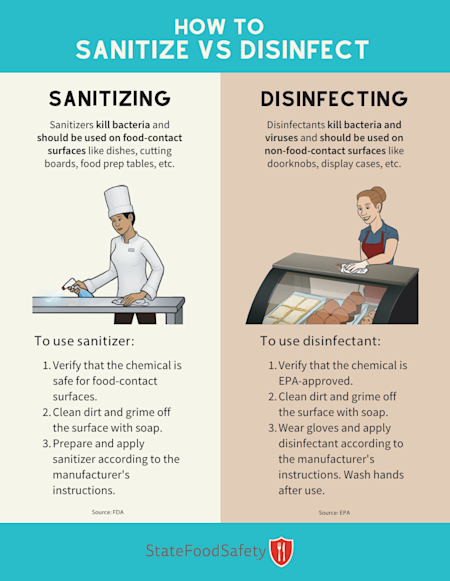
Sanitization reduces bacteria to levels considered acceptable by public health standards. It is especially important for food-contact surfaces and equipment.
In kitchens and food-service settings, sanitization may be needed for:
- Cutting boards
- Utensils
- Dishes
- Prep counters
- Equipment that regularly touches food
Sanitizing should generally come after cleaning. Cleaning removes visible dirt, grease and food residue, while sanitizing targets bacteria that may remain. If a surface is still visibly dirty, the sanitizer may not work as intended.
Always clean and sanitize your equipment and food-contact surfaces in the following situations:
- After touching or prepping raw meat
- If you are changing what food is being prepared
- After four hours of constant use
- After taking a break
In commercial kitchens, sanitizer effectiveness may also depend on concentration, water temperature and contact time. Test strips can confirm that chemical sanitizers are mixed at the correct strength.
What Does It Mean to Disinfect?
Disinfection achieves a higher level of germ control. While sanitizing reduces bacteria to safer levels, disinfection is meant to kill specific germs, including bacteria and viruses, based on the product’s label claims. Disinfectants are commonly used on:
- Bathroom fixtures
- Diaper-changing areas
- High-touch surfaces when someone is sick
- Areas exposed to bodily fluids
- Frequently touched non-food-contact surfaces
Disinfectants can also be used on food-contact surfaces in certain situations, but this is where it’s especially important to read the label.
The U.S. Food and Drug Administration (FDA) Food Code calls for disinfection when there may be a greater risk of spreading illness, such as after a surface has been contaminated with vomit, fecal matter, blood or other bodily fluids, or during certain foodborne illness situations.
Never assume a disinfectant is automatically appropriate for a cutting board, prep table or other surface that touches food just because it kills germs. Many disinfectants leave harmful residues, which may require additional cleaning steps to remove. Check where the product can be used on an object that touches food and whether rinsing is required.
And just like sanitizing, disinfecting works best on a clean surface, so be sure to clean first before applying the disinfectant.
When Should You Sanitize Instead of Disinfect?
The right choice depends on what the surface is used for and what kind of contamination you are trying to control. Sanitizing is usually the better fit when:
- You are working with food-contact surfaces.
- You need to reduce bacteria after cleaning.
- You are washing dishes or utensils.
- You are following routine food-safety procedures.
- A food-service regulation requires sanitizing.
Disinfecting is more appropriate when:
- Someone in the home or facility has been sick.
- You are trying to control viruses as well as bacteria.
- You are cleaning a bathroom or diaper-changing area.
- A high-touch surface needs a higher level of germ control.
- Workplace or facility procedures specifically call for disinfection.
For food-contact areas, remember to only use products that are approved for that purpose and follow the directions on the label.
Why Cleaning First Matters
Applying sanitizer or disinfectant directly to a dirty surface doesn’t allow these products to work they way they should.
That’s because crumbs, grease and other organic matter can get in the way. That means a surface may still need to be washed even if you plan to sanitize or disinfect it afterward.
In a food-service environment, a common process is:
- Remove visible debris.
- Wash the surface.
- Rinse as required.
- Apply an approved sanitizer.
- Allow the proper contact time.
- Let the surface air-dry or follow label instructions.
Following the steps in the right order maximizes the effectiveness of your cleaning.
The Importance of Contact Time
Spraying a product on and immediately wiping it away may feel efficient, but it may not give the product enough time to do its job.
Sanitizers and disinfectants often need to remain in place for a specific amount of time to function. This is known as contact time or dwell time.
Make sure to follow the manufacturer’s instructions, including the listed concentration, application method and contact time. Don’t assume every product works the same way.
Can One Product Sanitize and Disinfect?
Some products are designed and approved for both purposes. That doesn’t mean the directions are identical.
The concentration, application method or contact time required for sanitizing may be different from what is required for disinfecting. Always check the label to find out how the product should be used for the specific task.
Don’t rely only on words such as “antibacterial” on the front of a container when selecting chemicals. The detailed directions tell you how to use the product safely and effectively.
Use Cleaning Chemicals Safely
Whether you are sanitizing or disinfecting, be sure to understand the purpose of different cleaning chemicals before use. Follow dilution instructions carefully, keep chemicals in properly labeled containers and store them away from food.
Never mix cleaning chemicals unless the manufacturer specifically says it is safe to do so. For example, mixing bleach with ammonia can create toxic chloramine gas, which can cause coughing, breathing difficulty, chest irritation and other serious health effects.
Knowing when and how to clean and sanitize is just one part of maintaining a safe food preparation environment. StateFoodSafety’s food handler courses can help reinforce practical food-safety habits, including proper cleaning, sanitizing and contamination-preventing practices.